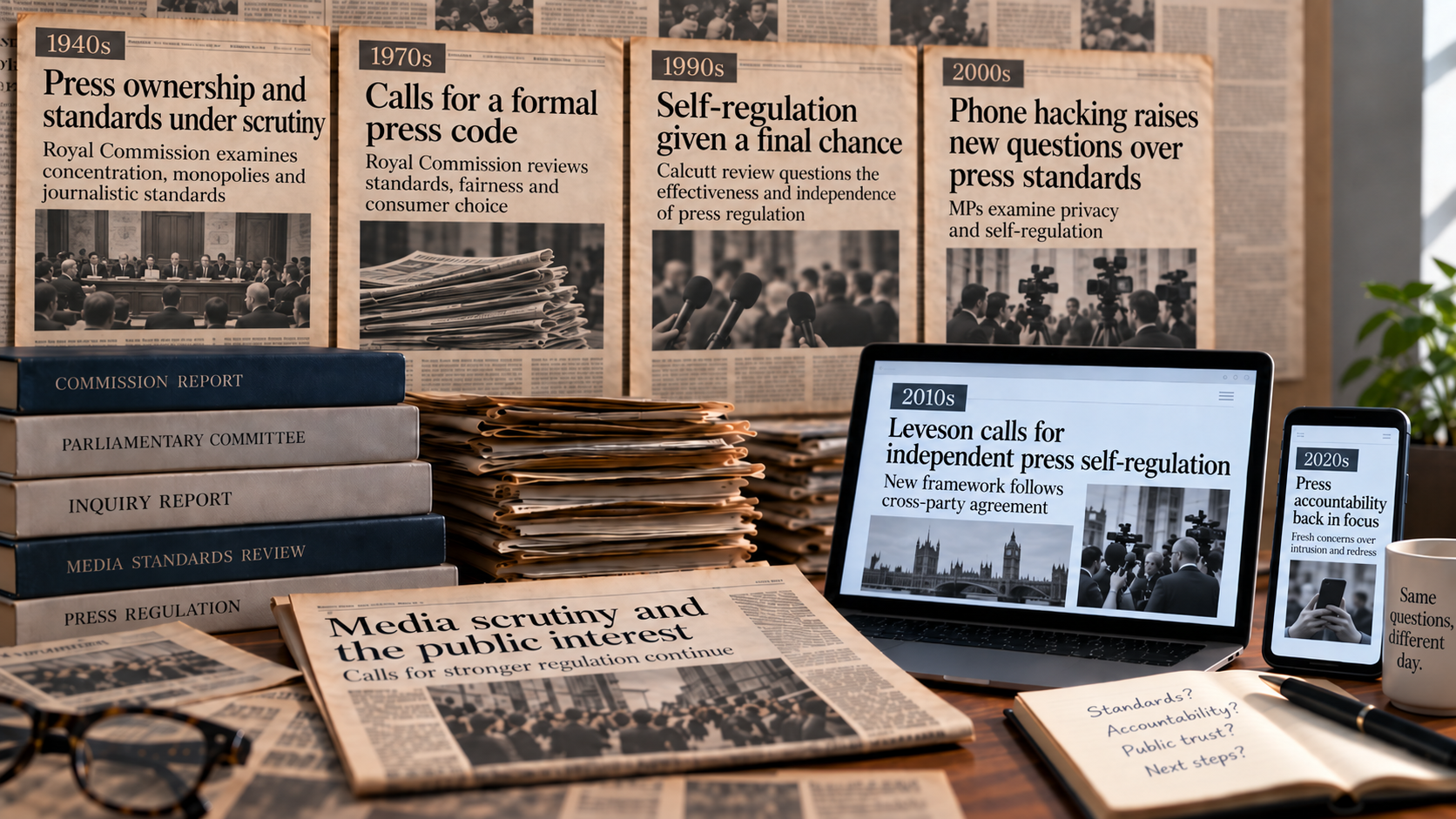
Since Parliament agreed to the creation of the Recognition System following the Leveson Inquiry’s recommendations, a familiar refrain has emerged from a certain section of the press: the claim that this system is ‘state-backed’. This assertion is not only false but also deliberately misleading – the Recognition System was crafted with robust safeguards to ensure independence from political and industry interference.
If we reject independent press self-regulation and accept the argument that ‘state-backed’ regulation threatens freedom of speech – a claim that lacks clear evidence when you consider the experience of broadcast journalism under Ofcom’s statutory regulatory framework – what alternatives remain?
The answer is industry-controlled self-regulation – a troubling callback to the failures of the Press Complaints Commission (PCC). History has shown us the dire consequences of allowing the press to police itself – a phenomenon known as ‘regulatory capture’. This occurs when self-regulators prioritise the interests of the industry over public accountability.
Take, for instance, the General Medical Council (GMC). Heavily criticised in the Shipman Inquiry for being ‘overly protective of doctors, at the expense of public safety’ and its ‘lack of independence from the profession it was meant to regulate’, the GMC underwent fundamental reforms following the Inquiry’s recommendations. Similarly, the Financial Services Authority (FSA) was implicated in the 2008 Global Financial Crisis due to its close ties with the banking industry – the so-called ‘revolving door’. It was eventually abolished and replaced by the Financial Conduct Authority (FCA), although concerns about its effectiveness remain.
The PCC’s failure to meaningfully address the allegations of widespread phone hacking, exposed by The Guardian in 2009, is another cautionary tale. In what is perhaps the most prominent example of regulatory capture, the PCC attempted to downplay these allegations, reassuring Parliament via the Select Committee on Culture, Media and Sport that phone hacking was the ‘deplorable, illegal and unethical behaviour of two people’.
The Leveson Inquiry laid bare that, in reality, phone hacking was just the tip of the iceberg. Blagging bank details, DVLA records, and medical records; impersonating police officers and civil servants; bribery; hacking emails; bugging devices; theft of private correspondence; breaking and entering; harassing bereaved individuals; doorstepping vulnerable people; and publishing leaked court documents – the list of press misconduct goes on and continues to this day. Unsurprisingly, the Leveson Inquiry concluded that ‘The PCC is constrained by serious structural deficiencies which limit what it can do’.
The Government and a section of the industry claim that the PCC was fundamentally reformed by the establishment of the Independent Press Standards Organisation (IPSO) following the Leveson Inquiry. They tout IPSO as a ‘tough new regulator’ and a part of the ‘system of independent press self-regulation’.
However, the reality is starkly different. The industry has designed IPSO to replicate many of the structural deficiencies that plagued the PCC. Its industry funding body retains the power to interfere with Board and Complaints Committee appointments and control the standards code that IPSO is supposed to enforce. Moreover, IPSO lacks the authority to hold oral hearings to test evidence, requires no mandatory apologies, and has not seen a meaningful funding increase from the days of the PCC (described as ‘barely enough’ in the Leveson Inquiry). Despite having the theoretical power to issue fines and launch investigations, IPSO has shown a troubling reluctance to act.
The industry has the power to rectify these issues and allow IPSO to do its job more effectively. It could amend IPSO’s Articles of Association to protect its independence, remove industry influence over appointments and standards, implement a compulsory arbitration scheme for all news publishers, and ensure transparent funding mechanisms. This would provide the necessary resources to handle the 20,000 complaints IPSO receives on average each year (based on total complaints received in the five years 2018-2022).
But they don’t.
Why? Because relinquishing control would complicate their ability to trade political influence for commercial gain. If this section of the press were genuinely committed to reform, they would act on the findings of IPSO’s own review and take steps towards implementing independent press self-regulation – funnily enough, a system closely resembling the Recognition System and the recommendations of the Leveson Inquiry.
Enough talk – walk the walk.
It is time for action. Allow IPSO to do its job credibly, or admit that the reluctance to change stems from a desire to maintain the status quo. As history has shown, the consequences of doing nothing can be devastating.