Serious questions about press conduct and accountability have resurfaced time and again over the years, and the tragic death of Professor Jason Arday has brought them sharply back into focus.
Before his death, Professor Arday faced intense and sustained media scrutiny, with race at the centre of the framing from the outset. We should not speculate about the causes of his death or attribute responsibility for it. But the scale and intensity of the coverage he faced deserve examination in their own right, particularly given the concerns repeatedly expressed by people close to him about its impact.
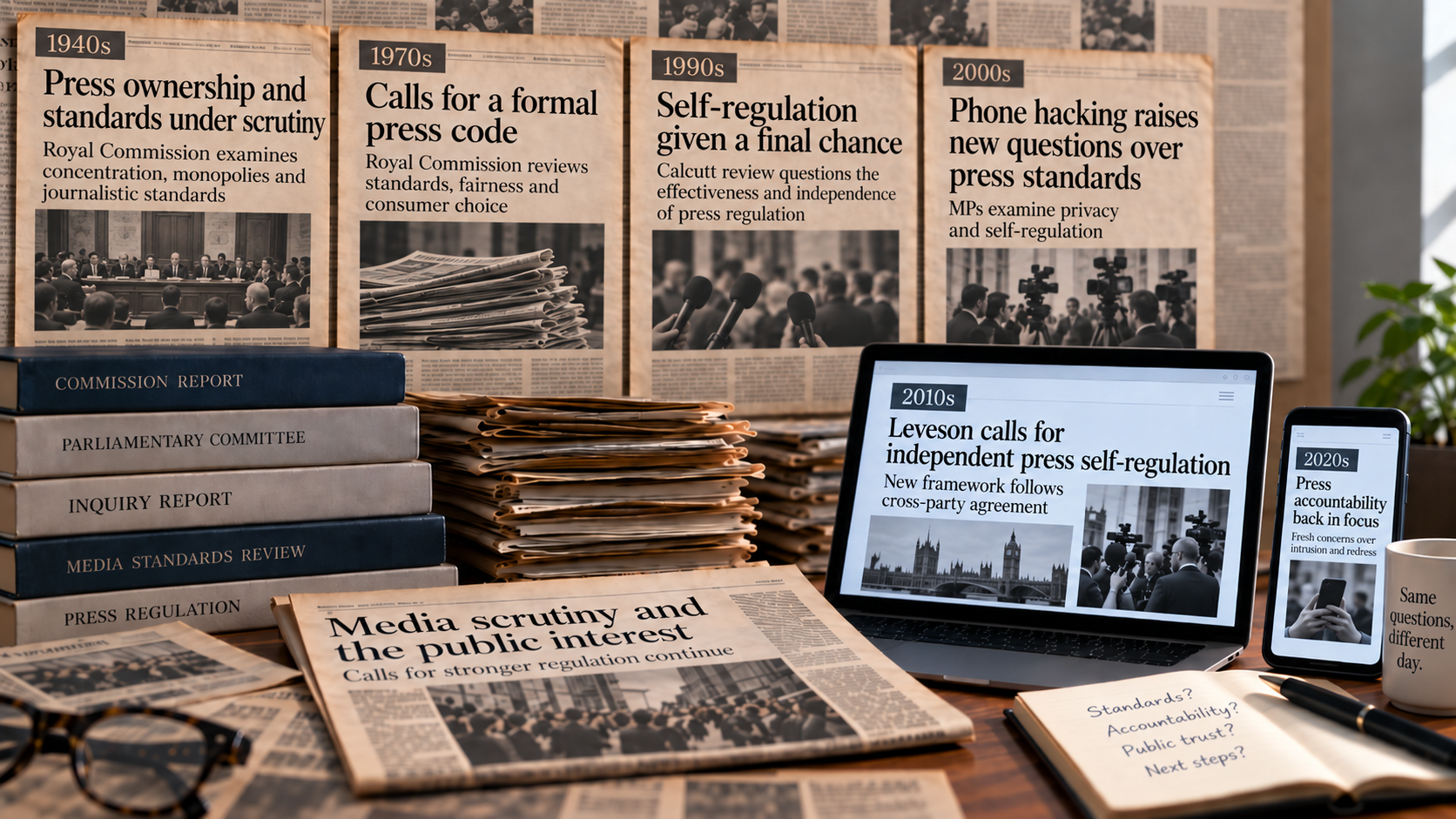
This is not a new problem. For around eighty years, Royal Commissions, parliamentary committees and public inquiries have examined concerns about press standards, intrusion and accountability. Again and again, reform has followed, but the underlying problem has never fully gone away.
The uncomfortable truth is that the system for holding the press to account remains deeply uneven. Most people think that print newspapers, magazines and online news publishers are independently regulated. In reality, most news publishers – including all the major national titles – remain outside any system of independently assessed regulation.
That is why we must be wary of collective amnesia.
A pattern that keeps returning
People being subjected to intrusive, relentless or disproportionate press attention – whether famous or previously unknown to the wider public – is a phenomenon stretching back decades.
In 2020, the death of television presenter Caroline Flack prompted renewed public debate about the treatment of individuals by the press after a period of intense tabloid scrutiny.
Seven years earlier, primary school teacher Lucy Meadows had become the focus of national media attention after her gender transition became public. Following her death in 2013, the coroner strongly criticised the “sensational and salacious” coverage and the way she had been treated by sections of the press.
The pattern goes back much further. In 1978, Birmingham virologist Professor Henry Bedson came under intense press scrutiny after a fatal smallpox outbreak was linked to the laboratory he led. Following his death, the coroner concluded that press harassment had contributed to the mental exhaustion that led him to take his own life.
The circumstances of these deaths were very different. In most instances, it would be wrong to draw a simple causal line between press coverage and any individual tragedy. That is not the point.
The point is that the same concerns keep returning. An individual becomes the focus of intense media scrutiny; events take a tragic turn; questions are raised about intrusion, proportionality and accountability; the news cycle moves on; and public concern eventually fades.
These individual cases are just the tip of the iceberg. The wider pattern is one of public outrage, promises of reform, and resistance to meaningful change in how the press is held to account.
Much about the press has undoubtedly changed over the years. Newsrooms, technology and the way journalism reaches audiences have been transformed. But this recurring experience of individuals being subjected to intrusive, relentless or disproportionate press attention sadly has not disappeared.
Forty years of warnings and reform
The most recent cycle of attempts to address these concerns began nearly forty years ago. David Mellor warned in 1989 that the press was ‘drinking in the last chance saloon’ following a period of increasingly intrusive practices. These included a journalist entering an actor’s hospital room and interviewing him when he was in no fit state to consent after a serious car accident, and a newspaper considering it acceptable to publish a photograph of a rape victim on its front page.
The Committee on Privacy and Related Matters, chaired by David Calcutt, reported in 1990 and recommended stronger press self-regulation. The Press Complaints Commission replaced the Press Council.
But when Calcutt returned to the issue three years later, he concluded that the PCC had failed to deliver effective self-regulation and recommended statutory intervention if the industry could not produce a satisfactory alternative.
His warnings were followed by another cycle of political and industry resistance.
Then came phone hacking.
In the 2000s, revelations of serious and, in some cases, criminal press misconduct again exposed fundamental weaknesses in press accountability. In 2011, under intense public and political pressure, the Leveson Inquiry was established.
Lord Justice Leveson concluded that the PCC had failed to provide effective accountability and recommended a new system of genuinely independent press self-regulation – independent of both Government and the industry.
A system left unfinished
Following cross-party agreement, the Royal Charter on Self-Regulation of the Press was granted in 2013. It established the framework for the Recognition System and provided for the creation of the Press Recognition Panel, an independent body set up to oversee regulation of the press and other news publishers.
We assess press self-regulators against criteria designed to ensure they are independent, properly funded, and able to protect the public while safeguarding freedom of expression.
Participation by news publishers remained voluntary, but legislation included incentives intended to encourage participation in a recognised regulator and provide protections for both the public and publishers choosing independent regulation.
The key incentive intended to encourage widespread participation was never brought into force and has since been repealed, with no alternative put in its place.
The result is a voluntary system without the mechanisms originally intended to encourage widespread participation.
Many publishers, including all the major national news publishers, remain outside the Recognition System. Some instead belong to the Independent Press Standards Organisation (IPSO), the industry-established successor to the PCC.
IPSO has never sought recognition. It does not meet the Royal Charter criteria for an independent and effective press self-regulator. Its structure remains influenced by the industry it is supposed to hold to account, and it operates under an Editors’ Code written by an industry-controlled committee.
Other publishers operate their own in-house complaints systems. These are not independent of the publishers themselves, and little publicly available information shows how effective they are.
What happens now?
In 2025, the Secretary of State for Digital, Culture, Media and Sport met families affected by press intrusion. She described it as a ‘harrowing meeting’ and said that the Government was ‘committed to working with them to resolve these issues’.
More recently, during debate on the Watch this space: a new strategic direction for UK media Green Paper, she said that ‘action is needed to better protect people in this space’, adding that the Government was ‘determined to take that action’.
But what that action will be remains unclear.
Professor Arday’s case has brought these questions back into focus.
The lesson of the last forty years is that the same concerns about press conduct and accountability keep coming back because the underlying accountability gap has never been properly resolved.
Public outrage cannot simply be allowed to fade until another individual or family finds themselves at the centre of the next controversy.
Our polling found that six in ten people believe politicians often avoid challenging the press to stay on good terms with it.
But at what price?
Collective amnesia is not a regulatory policy.