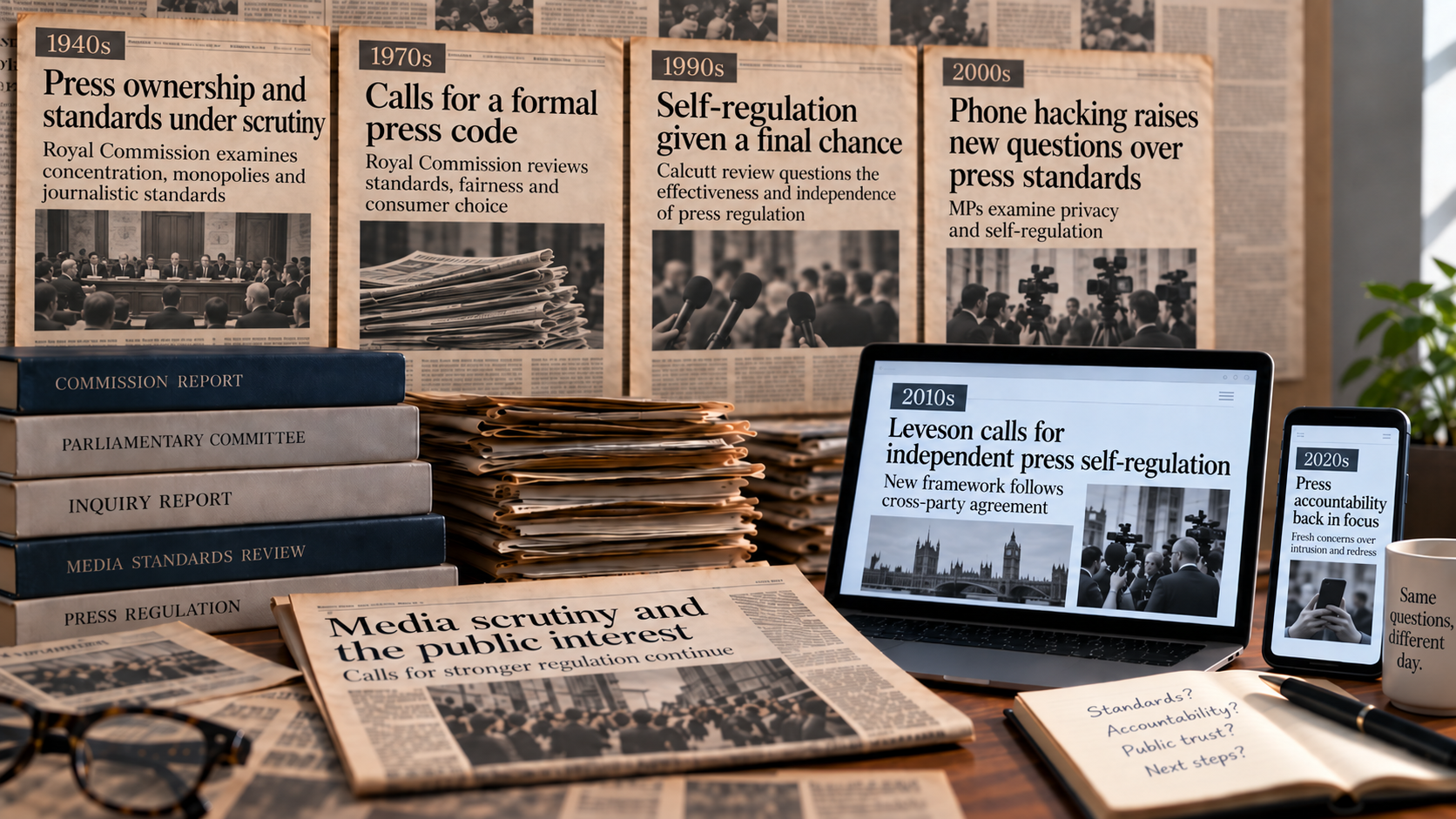
The UK Government continues to repeat its commitment to an independent self-regulatory regime for the press that supports press freedom and ensures the public has access to trustworthy information from a range of different sources. We could not agree more with this sentiment, but reconciling politicians’ words with their actions – or more accurately, inaction – proves challenging.
Since a new system of independent press self-regulation was set up in 2013 following the Leveson Inquiry recommendations, the reforms have been gradually undermined and rolled back by successive governments, with the backing of a powerful section of the press.
While many news publishers have joined the currently only independent press self-regulator, Impress, the vast majority of the press, including most of the large national titles such as The Daily Mail and The Sun, have refused to engage with the Recognition System. Instead, they have opted to join the Independent Press Standards Organisation (IPSO), which does not meet the requirements for independence, impartiality, or effectiveness of an Approved Regulator like Impress. Other titles, including The Guardian, Financial Times, and The Independent, operate in-house complaints and standards processes without external assurance, and an unknown number have no standards or complaints systems at all.
Despite the existence of an independent press self-regulatory system, it cannot work as intended when such a large section of the press can abstain from it and proactively works to subvert it.
Impress has to demonstrate every three years that it meets the criteria for an independent press self-regulator. Meanwhile, for IPSO’s members and those news publishers doing their own thing, the public must take them at their word that they are exercising their freedom of speech responsibly.
IPSO would say it has commissioned two external reviews that provide assurance its systems are robust. However, on closer inspection, these reviews highlight issues that should give us all cause for concern and have not been addressed in the 10 years since its formation. In particular:
- the industry’s controlling interest over editorial standards,
- IPSO’s reluctance to launch a standards investigation or issue fines,
- downward pressure on previously agreed funding amounts,
- and the constraints on IPSO’s ability to adapt its model in a changing press landscape.
Worse still, for those news publishers who operate in-house standards and complaints systems, the public cannot even get a peek behind the curtain.
The Ipsos Veracity Index ranks journalists towards the bottom of the league table when it comes to public trust. They are below estate agents, landlords, and bankers. Politicians fare even worse. Therefore, being asked to accept that press regulation is working by both the Government and news publishers themselves when these two groups do not appear to command public confidence is a tall ask.
Trust must be demonstrated over time and earned, not simply demanded – it is a reciprocal relationship between two parties. As former US President Ronald Reagan would say, quoting an old Russian proverb, ‘Trust, but verify’. How can we trust the press to provide accurate information when there is no reliable method to verify that trust for a large proportion of the industry? This is precisely why the Recognition System was established: to provide genuinely independent, consistent, and ongoing assurance that press regulators are acting both to uphold news publishers’ freedom of speech and to properly protect the public.
Let’s remind ourselves of the consequences of a weak accountability system. During the Leveson Inquiry, IPSO’s predecessor, the Press Complaints Commission (PCC), was identified as a key enabler of press misconduct. We should not forget that it attempted to provide false reassurance to the public and Parliament regarding the extent of press criminality.
There may not be a ‘smoking gun’ right now to match the evidence of widespread phone hacking uncovered by The Guardian in 2009, but numerous cases exist where IPSO has failed to act properly or effectively to shield individuals and groups from press harm. We can already see history repeating itself with assertions from the Government and the industry that the current state of press regulation is sufficient and no change is required. At the same time, standards are not upheld, and the public remains unprotected.
While we are constantly reassured that independent press self-regulation is important to the Government, its inaction to address these weaknesses tells a different story. It reeks of an unwillingness to challenge powerful voices in the industry, while giving hollow assurances to victims of press intrusion who continue to be harmed.
The can is well and truly being kicked down the road, leaving the public vulnerable and the promise of press accountability unfulfilled.
Part 1 of the Leveson Inquiry gave us the answer – all it needs is the political will to implement it.