
This page lists the Press Recognition Panel’s (PRP) organisational and external policies.
Introduction
Purpose and scope
Bribery
The PRP operates a zero-tolerance policy towards offering and accepting bribes. This includes facilitation payments and bribes under duress.
Money laundering
Fraud and theft
The PRP operates a zero-tolerance policy towards fraud and theft.
Corruption
Prevention and detection
Reporting concerns
Investigation
Further concerns following investigation
Monitoring and review
Reviewed: April 2026 (AGR)
Purpose
The purpose of the Audit and Risk Committee (ARC) is to support the Board in its responsibilities in terms of control, governance and risk management. Its detailed remit is to:
The Committee’s duties are as follows:
Membership, Chair, Quorum
Access
Frequency and Notice of Meetings
Minutes of Meetings
Accountability & Reporting Responsibilities
Other
Review
Reviewed April 2026 (AGR)
Introduction
Statement of Policy
Future reviews of remuneration
Pension scheme contributions
Updated: February 2026 (AGR)
Reviewed: February 2026 (AGR)
Purpose
Scope
General Principles
Gifts
Hospitality
Fees for speeches or other work carried out
The Gifts and Hospitality Register
Expenses
Scope
Responsibilities
Expenses
Travel and Subsistence Costs
15.1actual payments for the most cost-effective travel by standard class, a flexible return or the cost equivalent public rail transport. Any requests to travel other than standard class should be forwarded with an explanation of the circumstances to be approved by the Chief Executive. The test of reasonableness will apply
15.2cost is assumed to apply to travel from the claimant’s principal place of residence within the UK. Where this is not the case, the expense claimable would be the lower of the actual cost of travel, and travel from the principal UK residence. Any exceptional circumstances requires approval by the Chief Executive
15.3the same principles applied to rail travel apply also to air travel;
15.4for travel by private car, 55 pence per mile for the first 10,000 miles, 25 pence per mile on each additional mile over 10,000 miles (in accordance with approved HMRC mileage rates as of 6 April 2026), and actual parking fees and congestion charge;
15.5for travel by motorcycle, 24 pence per mile;
15.6for travel by bicycle, 20 pence per mile;
15.7for travel by underground or bus including where oyster card or contactless payment is used, reimbursement of the published fares (where evidence of the journey is not readily available).
16.1£10 for qualifying travel of 5 hours or more,
16.2£15 for qualifying travel of 10 hours or more;
16.3£30 for qualifying travel of 15 hours or more; and, where the travel is ongoing after 8pm;
16.4for each night’s absence in respect of accommodation up to £200 per night plus VAT. This must not include any extras such as alcohol or newspapers. These must be paid for separately by the claimant;
16.5any hospitality to third parties must be approved by the Chief Executive and must be in accordance with the PRP’s policy on gifts and hospitality (e.g. hospitality for anyone who is not an employee).
Carer costs or other ‘reasonable adjustments’
Airline Frequent Flyer Schemes
Lost or Missing Receipts / Tickets
Authorisation
Notes
Updated: June 2026
Purpose
The Nominations Committee (NomCo) is an advisory committee and its purpose is to:
Membership, Chair, Secretary and Quorum
Frequency and Notice of Meetings
Minutes of Meetings
Accountability & Reporting Responsibilities
Other
Authority
Review
Introduction
Frequency of Meetings
Notice of Meetings
Agenda and papers
Executive attendance at meetings
Other attendees at meetings
Quorum
Chair
Declaration of Conflict of Interest
Order of Business
Voting
Deferral of Decision
Urgency
Governance and Records
Reserved Matters
1. Purpose
The Senior Independent Board Member’s role is to:
2. Responsibilities
The Senior Independent Board Member will as necessary and appropriate:
3. Term of Office
Reviewed: February 2026 (AGR)
Basis for appointment
Excluded and restricted activities
Confidentiality
Remuneration and time commitment
Expenses
Expression of views
Declaration of Registrable Interests
Resignation
Indemnity
Additional commitments
Basis for appointment
Restricted activities
Confidentiality
Remuneration and time commitment
Expenses
Expression of views
Declaration of Registrable Interests
Indemnity
Additional commitments
Updated: June 2026
1.1 Established by Royal Charter, the Press Recognition Panel (‘the PRP’) was granted funds from the Exchequer to enable the Board to commence its operations and fulfil its purpose for the first three years of operation. The grant of such monies was made in accordance with the general principles of Managing Public Money, and the PRP continues to ensure that it takes into consideration this guidance whilst in receipt of public funds.
1.2 The Chief Executive is designated as the Accounting Officer for the PRP and is personally responsible and accountable to Parliament for:
1.3 This document establishes the financial control framework for the PRP. It is set by the Board and is applicable to everyone who works for the PRP, to ensure that the Accounting Officer can undertake her duties in accordance with the law and the general principles of Managing Public Money, in order to achieve probity, accuracy, economy, efficiency and effectiveness. Failure to comply with the Finance policy could result in disciplinary action.
2.1 The Accounting Officer exercises financial supervision and control by:
2.2 The Accounting Officer is personally accountable to Parliament for the stewardship of the PRP’s funds, for the good management of the organisation, and for ensuring that the PRP meets its obligation to undertake its role and functions within the financial limits set. The Accounting Officer is responsible for signing off the PRP’s annual report and accounts.
2.3 The Accounting Officer will, as she deems appropriate, delegate detailed responsibilities to other staff (in writing) within an approved scheme of delegation.
2.4 The Accounting Officer must ensure that all of the Board and staff are notified of and understand their responsibilities within these financial procedures.
2.5 The Accounting Officer is responsible for:
2.6 The Accounting Officer is responsible for the procurement of goods and services including:
2.7 Staff are responsible for:
3.1 The Accounting Officer is responsible for the maintenance of appropriate financial systems in order to allow the Chair and Board to carry out their financial obligations. The financial systems must be properly described and kept updated.
3.2 The Accounting Officer will ensure maximisation of separation of duties so that individuals are protected from exposure to undue influence, unfair criticism or allegation.
3.3 The Accounting Officer will ensure that suitable back-up arrangements and/or reserve facilities are in place and that when required they can be invoked with sufficient speed to ensure that the operation and integrity of the services are maintained.
4.1 The Accounting Officer will compile and submit to the Board for consideration an annual proposed budget to finance the activities in the PRP’s work plan.
4.2 The Accounting Officer may delegate the management of a budget to permit the performance of a defined range of activities. This delegation must be in writing and be accompanied by a clear definition of: the amount of the budget; the purpose(s) of each budget, individual responsibilities and the provision of regular reports.
4.3 The Accounting Officer, with the assistance of the finance support provider (or equivalent) will devise and maintain systems of budgetary control and expenditure forecasting.
4.4 Budget holders are responsible for ensuring that expenditure is kept within budget. If budgets are exceeded then the reasons for this should be reported to the Accounting Officer, together with any proposed remedial action.
4.5 In accordance with para 11.9 of the Royal Charter, the Chair will appoint one Board Member to take specific responsibility for reporting to the Board on the management of the finances of the PRP. The Board member with this responsibility may be the Chair of the PRP’s Audit and Risk Committee. The finance support provider will meet the Board Member as required to discuss the PRP’s finances in detail. The Accounting Officer will also attend these meetings.
5.1 The financial year for the PRP is the period from 1 April to 31 March each year. The Accounting Officer will prepare annual accounts for each financial year in accordance with the Financial Reporting Manual issued by HM Treasury.
5.2 In accordance with Royal Charter, the Board must send a copy of the statement to the Comptroller and Auditor General (C&AG) as soon as practicable after the end of the financial year (para 12.2).
5.3 In accordance with any necessary arrangements made between the Comptroller and Audit General and the Press Recognition Panel, the C&AG will examine, certify and report on the statement each year (para 12.3). The PRP is required to lay a copy of the certified statement and the C&AG’s report before Parliament (para 12.4).
6.1. The Accounting Officer is responsible for managing the PRP’s banking arrangement within the parameters set by the Board.
6.2 The PRP is able to earn any interest on its balances – the PRP’s Investment policy provides further advice on the PRP’s policy on all investments.
6.3 All payments for invoices, for the salaries and expenses of staff and for the salaries and expenses of the Board will be paid by way of the Banking Automated Clearing Service (BACS). Adequate control mechanisms must be in place with the maximum practicable separation of duties for each payment mechanism.
7.1 The Accounting Officer is responsible for managing the payroll including making payments on agreed dates.
7.2 The Accounting Officer must be satisfied that proposed payments are supported by appropriate contractual evidence which have been appropriately authorised before confirming payment of the proposed payroll. The Accounting Officer will carry out such periodic checks to ensure that on-going payments are correct and due and these should be evidenced.
8.1. The Board delegates authority to the Chair to agree an increase to any additional hours required by the Chief Executive (within the agreed budgeted annual staff remuneration cost) to support the Board in meeting its Charter obligations. The Board will be provided with an annual update for audit purposes.
8.2 The Board delegates authority to the Chief Executive to agree an increase to any additional hours required by the Executive staff (within the agreed budgeted annual staff remuneration cost) to support the Board in meeting its Charter obligations. The Chief Executive will provide an annual update for audit purposes.
8.3 The Accounting Officer will determine the level of financial delegation to budget holders, within the overall scheme of financial delegation approved by the Board (attached at Appendix 1).
8.4 The limits are in respect of individual transactions within the budget and apply to authority to commit expenditure against the budget and to enter into formal contracts (as opposed to being centred on payments). The limits will be reviewed each year and agreed before the start of the year to which they relate. The limits apply to designated roles and therefore any changes to role holders do not require individual re-authorisation.
8.5 The Executive Administration Manager (or equivalent) will maintain an up-to-date record of authorised signatures and financial authorities on behalf of the Accounting Officer.
9.1 The PRP is committed to achieving value for money, in terms of quality and price, for all of its procurement activity. In order to achieve this, the PRP will endeavour to clearly communicate its requirements and evaluation criteria, as an informed purchaser, and to establish levels of competition appropriate to the size and complexity of the purchase in accordance with the procurement policy.
10.1 The Accounting Officer is responsible for ensuring that a system of verification, recording and payment of all amounts payable is in place. The system shall provide for certification that the goods or services invoiced were supplied in the time and manner and to the standard ordered before correct payment is made.
10.2 All properly authorised and approved invoices should be routinely paid within supplier terms or 30 days of receipt unless a longer payment term has been agreed or there is a dispute. The PRP will aspire to pay all properly authorised and approved invoices within 10 working days; the PRP abides by the provisions of the prompt payment code.
10.3 Budget holders are responsible for ensuring that invoices received for checking are returned promptly to the Accounting Officer.
10.4 The Accounting Officer will ensure that payments are made to creditors by way of the Banking Automated Clearing Service (BACS). Adequate control mechanisms must be in place with the maximum practicable separation of duties for each payment mechanism.
11.1. The Accounting Officer is responsible for maintaining an asset register of all capital assets leased or owned by the Panel. In addition, the finance support provider will ensure that an inventory is maintained of all valuable, attractive and/or portable assets that belong to the PRP. In respect of fixed assets, items are capitalised where the purchase price exceeds £2,000.
12.1 The PRP Audit and Risk Committee has determined that an internal audit service is not currently required, and this position is being kept under review.
13.1 The National Audit Office (NAO) conducts the PRP’s annual external audit in accordance with International Standards on Auditing (UK and Ireland) (ISAs (UK and Ireland)), so as to enable the Comptroller and Auditor General to give an opinion on the financial statements.
13.2 Further details of the scope of the audit, as well as the NAO’s and PRP’s respective responsibilities are set out in the letter of engagement, which is available in the correspondence section of the website.
13.3 The Audit and Risk Committee considers an audit planning report from NAO ahead of the start of the external audit each year. This document explains:
14.1. Board Members and staff of the PRP have a responsibility for ensuring compliance with Parliamentary requirements on the control of public expenditure and financial regularity and propriety.
14.2 Regularity is the requirement for all spending to accord with the relevant legislation, the relevant delegated authority, and the general principles of Managing Public Money.
14.3 Propriety requires spending to respect Parliament’s intentions, conventions and control procedures, including any laid down by the Committee of Public Accounts.
14.4 In dealing with fraud, corruption or other financial irregularity the Chief Executive, as Accounting Officer, is responsible for ensuring that a robust system of internal control is in place within the PRP which includes effective anti-fraud and corruption controls.
14.5 Board Members and staff have responsibility to prevent, report and detect fraud and corruption.
14.6 Anyone who suspects fraud or other financial irregularity must immediately report the matter to the Accounting Officer. In the event that the matter concerns actions by a Board member, the report should be made direct to the Chair of the Board. Concerns about the Chair should be made to the Senior Independent Board member. The PRP has a separate Anti-bribery, money laundering, fraud, theft and corruption policy which should be referred to as appropriate.
15.1 Special payments:
15.2 Losses:
Appendix 1
Scheme of financial delegation
The Chief Executive is the PRP’s designated Accounting Officer and holds accountability for the PRP’s budget.
Non-payroll expenditure
In order to provide adequate scrutiny of financial decisions, the following limits define levels above which financial decisions need to also be agreed by the Board, for non-payroll expenditure:
Corporate Credit cards – overall company monthly limit £11,250
The Chair and the Executive Administration Manager hold corporate credit cards, with a maximum monthly limit of £2,500. The Executive Administration Manager has financial delegation limits for subscriptions and office sundries and the Chief Executive approves the remainder (in accordance with limits in the budget) in advance.
All credit card purchases must be approved in advance by the Chief Executive regardless of amount. The PRP credit card details must not be stored on any online payment portals/wallets and must be removed immediately on confirmation of receipt for all transactions undertaken on behalf of the PRP.
Payroll costs
Any changes to payroll costs are agreed by the Chief Executive (and Chair, if appropriate).
Payments from bank accounts
All payments from the Panel’s bank accounts (including transfers between the Panel’s bank and fixed term deposit accounts) must be authorised on the bank by any two of the following:
Updated: February 2026 (AGR)
Scope
Security
Credit Risk
Interest Rate Risk
Currency Risk
Liquidity
Standards of care
Prudence
Ethics and conflicts of Interest
Delegation of Authority
Checks and balances
Investment transactions
Internal Controls
Eligible Investment
18.1Deposits — The Board may invest funds regulated by the FCA to meet short-term liquidity needs in instant access saving accounts and in fixed-term deposits. The maturity of these will vary to coincide with expected cash demands. Any deposit investment is restricted to at least High Grade ratings by relevant ratings agencies.
18.2Bonds — The Board may only invest in Bonds which are issued by the UK government and purchased on the Stock Exchange or directly from the Treasury. Bonds may also be purchased through authorised dealers and banks.
18.3Shares or other securities — The Board will not invest in either public or private equity or other securities.
Investment Restrictions and Prohibited Transactions
Performance Review and Reporting
Record Keeping and Safekeeping
Policy Considerations
Risk policy purpose
Risk policy objectives
Risk policy statement
Roles and responsibilities
Interaction with other policies
Principles overall
Matters reserved to the Board
(1) Royal Charter
(2) Organisational Issues
(3) Management Issues
(4) Financial Reporting and controls
(5) Board Membership and other appointments
(6) Delegation of Authority
(7) Governance
(8) Legal
Reviewed: February 2026 (AGR)
1. Introduction
Artificial Intelligence (AI) is becoming integral to many organisations’ operations, offering opportunities for automation, insights, and efficiency. However, the use of AI also brings challenges and risks that must be managed carefully.
2. Purpose and Scope
The purpose of this framework and policy is to provide guidance, principles and processes that should be considered and followed when using or implementing AI systems within or on behalf of the organisation. It is designed to ensure that AI technologies are used safely and responsibly, addressing legal, ethical, and operational considerations, while fostering awareness of the evolving risks and opportunities that AI presents.
It serves as a flexible framework that can be adapted to the specific needs of the PRP as the use of AI evolves. It applies to all AI tools, models, and platforms which may be used by the organisation, its staff and contractors, as well as the data and systems they interact with.
3. Policy Definitions
| Term | Definition |
|---|---|
| Artificial Intelligence (AI) | A range of algorithm-based technologies and approaches that mimic human intelligence by enabling machines to learn, reason, and make decisions to solve complex tasks. |
| AI Systems | A machine-based system that uses one or more AI technologies, data and processes to make inferences and generate outputs (such as predictions, content, recommendations or decisions) which influence environments or actions. An AI system may operate autonomously or with human oversight. This includes generative AI tools such as ChatGPT, Copilot, and similar systems. |
| AI Governance | A framework of policies, procedures and oversight mechanisms that oversees the ethical, legal, and safe technical management of AI systems with appropriate accountability, transparency, and risk management. |
| AI Technologies | AI methods, models, and tools used to develop and operate AI Systems, including – without limitation – supervised, unsupervised, and reinforcement learning; deep learning; predictive analytics; natural language processing; computer vision; speech or image recognition; and statistical or rule-based approaches. |
| Data Integrity | The accuracy, completeness and consistency of data used in AI systems. |
| Bias | Unfair or discriminatory outcomes produced by an AI System due to flawed data, design, or assumptions. |
| Ethics | Principles of fairness, accountability, transparency, and responsibility as they relate to the use of AI. |
4. Policy Statements
4.1 Transparency and Disclosure
The PRP is committed to openness and transparency about its use of AI in its work, and in the services provided by its suppliers, and to ensuring that any use of AI meets the legal, ethical, and operational standards expected of a body exercising a public function.
These include:
The PRP does not currently provide, deploy or endorse the use of AI or AI Systems or Technologies in delivering the PRP’s public functions and no uses of AI meets the threshold for public reporting at this time. This Statement will be updated on the PRP’s website whenever material changes occur.
5. Artificial Intelligence (AI) Policy
This Policy sets out the principles and processes to identify and manage risks associated with the use of AI Systems and Technologies. It is intended to ensure the responsible use of AI to safeguard the PRP’s operations, reputation and compliance with legal requirements.
6. Scope
This Policy applies to all PRP staff, including board members, contractors and suppliers, when:
7. Policy Principles
8. AI Systems
The PRP does not provide or endorse the use of AI Systems or Technologies for staff or contractor use. No AI System or Technology may be installed or used on PRP systems or networks without pre-approval in writing from the Chief Executive, following a formal review, disclosure, and the assessment and mitigation of potential risks.
If staff or contractors access publicly available AI tools in relation to PRP-related activities, these Policy requirements must be strictly adhered to.
9. Data Sensitivity and Protection
Any AI System or Technology used for any purpose related to the organisation may only be used to process data that is strictly appropriate for the intended task, with proper legal grounds, permissions and security protections, such as anonymisation or encryption where necessary.
10. Prohibited Uses
10.1 Confidential Information
Staff must not use AI Systems or Technologies for tasks using or involving:
10.2 Public Functions
AI-generated outputs may contain biased, inaccurate, inappropriate or infringing data which could lead to harm if used without proper validation or attribution. Staff must not use AI Systems or Technology for any Public Function purpose without prior written approval from the Chief Executive and appropriate Oversight:
The PRP will maintain a transparency record on its website of any instance where AI is used in materially delivering the PRP’s public functions or significantly influences PRP decisions, recommendations, or reports.
11. Internal Use
Subject to the provisions of this Policy, the PRP does not prohibit staff from accessing publicly available AI Systems to support limited PRP-related activities as follows:
Provided that staff only input publicly available or anonymised non-sensitive data which is not subject to Prohibited Use restrictions above.
While AI tools may assist with routine and repetitive tasks, staff remain fully accountable and responsible for verifying the accuracy, appropriateness, and legality of any AI-generated outputs before incorporating them into final work product and for ensuring it aligns with the PRPs standards and this Policy.
12. Engaging Suppliers
Staff must be particularly aware of AI risks in supplier interactions. Staff must review, assess and mitigate supplier disclosures on AI for potential risks in accordance with the Supplier Checklist and, where deemed necessary, include AI-specific clauses to mitigate risks in accordance with the Procurement Policy.
Any concerns or questions about supplier AI systems must be reported without delay to the Chief Executive.
13. Incident Reporting
Staff must promptly report any AI incidents or breaches of this Policy to the Chief Executive in accordance with the Risk Management Policy, for example where:
In the event of receiving a report the Chief Executive shall follow the Risk Management Policy and related incident management procedures to mitigate any risks, investigate the issue, and ensure that the Board is kept appropriately informed.
14. Risk Assessment
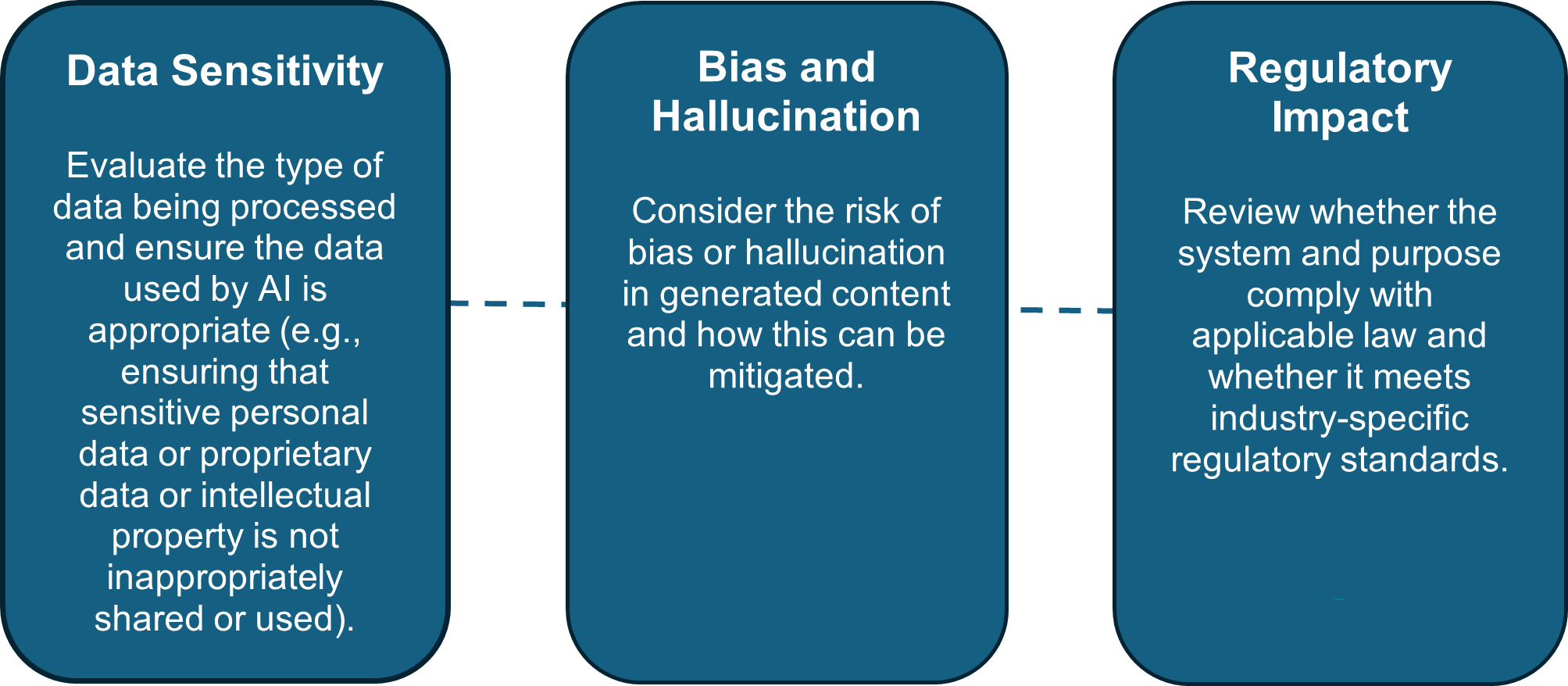
Any AI Systems being considered for deployment by the PRP or its contractors must undergo a risk assessment before being implemented or used to assess their scope and potential impact. This includes evaluating the type of data the system processes, the potential risk of bias, hallucination or discrimination, and ensuring compliance with relevant regulatory frameworks.
Framework to evaluate risks:
15. Governance and Oversight
Updated: 20 January 2026 / WC
Definition
Implementation
Objectives and strategy
Roles and responsibilities
Corporate standards and guidance
Updated: April 2026 (AGR)
1.1 This document sets out our policies on the rights of individuals under Data Protection Legislation. The individual rights covered in this policy are:
1.2 The General Data Protection Regulation (GDPR) together with the Data Protection Act 2018 (the Data Protection Legislation) sets out the responsibilities of those dealing with personal data and the rights of individuals to access their personal data. All staff, contractors and any third party working on behalf of the Press Recognition Panel (PRP) are contractually bound to comply with the Data Protection Legislation and other relevant policies.
2.1 Data Protection Legislation gives you the right to confirmation that your data is being processed, to know what information is held about you, how that information is processed, and receive access to this data. It provides a statutory framework to ensure that personal information is handled properly.
2.2 The purpose of allowing access to personal data is so that you are aware of and can verify the lawfulness of the processing.
3.1 Personal data means any information relating to an identified individual or identifiable natural person (“Data Subject”); an identifiable natural person is one who can be identified, directly or indirectly, in particular by reference to an identifier such as a name. This includes any expression of opinion about the individual and any indication of the intentions of the Data Controller (i.e. the PRP).
3.2 This applies to both information held electronically and manually.
4.1 The PRP is committed to being transparent over how we use personal data.
4.2 We inform people how we use their personal data through our privacy statement (published on our website) and we may make other information available depending on the circumstances.
What is the PRP’s general policy on providing information?
5.1 We are committed to operating openly and responding to all requests for information. We welcome ‘informal’ requests and these may be a quicker and more effective way for you to access particular information. We will explain to you whether we are able to comply with any particular request.
5.2 If you wish to make a ‘formal’ subject access request, in accordance with the provisions of Data Protection Legislation, we will provide you with:
How do you make a right of access (subject access request)?
5.3 A subject access request (“SAR”) must be made in writing and we will require you to provide your full name and a contact address (either a postal address or an email address) and details of the specific information you require and any relevant dates.
Confirmation of Identity
5.4 The PRP recognises that individuals may initially seek to exercise their subject access rights in a range of different ways including by telephone. However, because of the statutory requirement to be satisfied as to the applicant’s identity, the PRP will ordinarily ask any prospective applicant to provide written confirmation (via email or letter). We will not progress a SAR until we are satisfied as to the applicant’s identity. We will routinely ask for a copy of a passport, driving licence, bank statement or other proof of identity.
5.5 Where we are satisfied as to the identity of the person making the request (for instance if a request were made by a current or past employee), we may elect to waive the requirement for the applicant to provide proof of identity. The decision to waive proof of identity will be taken by the CEO.
What is the timeframe for responding to subject access requests?
5.6 We will log the date the request was received (and the applicant’s identity confirmed).
5.7 We will seek to provide you with the information as soon as possible and not later than one month of receipt. If a request is particularly complex or numerous requests have been submitted we may extend the response time by up to two further months. However, if this is necessary we will contact you within a month of your original request to advise you of this and to explain the reasons why. We will seek to provide as much information as possible as early as possible within that period and may make a ‘staged’ disclosure of information.
5.8 We will inform you without delay, and no later than one month after receiving the request, if we do not intend to take action in response to the request, including the reasons why the PRP does not intend to take action in connection with the request and the right to make a complaint with the ICO or seek a judicial remedy.
What do we do when we receive a subject access request?
Collation of information
5.9 We will undertake a reasonable and proportionate search for the personal data requested, in conjunction with other relevant staff who will be responsible for assisting the team to locate and extract any relevant personal data.
5.10 We will check that we have enough information to find the information you have requested. If we feel we need more information in order to clarify the request, then we will promptly ask you for this.
Issuing our response
5.11 Once any queries that PRP may have around the information requested have been resolved, a copy of the information will be provided to you.
5.12 Before sharing any information that relates to third parties, we will where possible anonymise information that identifies third parties unless it is reasonable to disclose that information or we have their consent. Whilst the right under Data Protection Legislation is to “personal data”, rather than documents, we will where appropriate and as a matter of discretion, try to provide you with contextual information or entire documents to help you understand your information.
5.13 We will explain any complex terms or abbreviations contained within the information when it is shared with you. Unless specified otherwise, we will also provide a copy of any information that you have seen before.
5.14 Where we hold data about a Data Subject, the PRP’s response shall contain the following information:
5.15 Any preferences of the data subject will be taken into account in determining the format in which the information is disclosed. Where the request has been made through electronic means (including email), in the first instance we will communicate our response in an electronic format, using PDF or other commonly accessible formats to provide personal data.
5.16 Appropriate security measures will be taken to protect data during the course of its disclosure, including encrypted transfer mechanisms. Where possible, the information will be disclosed in a secure, readable electronic format to minimise costs, provide an audit trail, protect the environment, and to promote the security of the information. Any personal data disclosed via hard copy will be sent via recorded delivery.
Will there be a fee?
5.17 Information will usually be provided free of charge.
Are there any grounds we can rely on for not complying with a subject access request?
Exemptions
5.18 Once all relevant information has been located, the CEO will review the data prior to disclosure and will be responsible for deciding whether any exemptions apply under Data Protection Legislation on a case-by-case basis.
Manifestly unfounded or excessive requests
5.19 If a request is manifestly unfounded or excessive, particularly if it is repetitive, the PRP can either charge a reasonable fee taking into account the administrative costs of providing the information or refuse to respond to the request.
5.20 Where we refuse to respond to the request we will explain why we have done so and advise of your right to complain to the ICO and to a judicial remedy. We will do this without undue delay and within one month.
5.21 In deciding whether multiple requests are excessive (or made at unreasonable intervals), and what action to take in consequence, the PRP will consider all the relevant factors, including the following:
5.22 A record shall be kept of the PRP’s decision making and this explanation will be given to the applicant. The applicant may ask for a review of the decision.
6.1 If we agree that the information is inaccurate or incomplete, we will rectify it and where practicable, destroy the inaccurate information. Please note that a difference in opinion or interpretation is not the same as an inaccuracy, but we may record your disagreement with the data in question.
6.2 If we have disclosed the personal data in question to a third party we will inform the third party of the rectification unless this is impossible or involves disproportionate effort. On request we will inform you of any third-party recipients.
6.3 We will respond to any request for rectification within one month although we reserve the right to extend this by two months where the request is particularly complicated.
6.4 If we do not agree the information is inaccurate or we cannot delete the information, we will make a note of the alleged error and keep this on file. We will also explain why this is the case and advise of your right to complain to the ICO and to a judicial remedy. We will do this without undue delay and within one month.
What is the right to erasure?
7.1 The right to erasure is also known as the ‘right to be forgotten’. This is effectively the right to request the deletion or removal of your personal data where there is no compelling reason for the PRP to process (or continue to process it).
When does it apply?
7.2 The right to erasure is not an automatic ‘right to be forgotten’ and your right to erasure only applies in certain circumstances including the following:
Situations where the PRP may refuse to consider a request
7.3 There are certain circumstances where the PRP may refuse to comply with a request. These may include the following:
How to apply
7.4 Should you wish to make such a request you should send us the request in writing. When we receive the request, we will send you written notice that either we have complied with your request, intend to comply with it or state the extent to which we will comply with it and why as soon as possible.
7.5 If we have disclosed the personal data in question to a third party we will inform the third party of the erasure unless this is impossible or involves disproportionate effort. On request we will inform you of any third party recipients.
When does it apply?
8.1 You also have a right to ask us to block or restrict processing of your personal data in some circumstances:
What we will do
8.2 Where we restrict the processing of your data we will continue to store it but will not process it further.
8.3 We will hold a log with the minimum amount of information necessary to ensure that we continue to be able to restrict the processing in future for example where we are required to back up the system we may need to check our records to ensure no information is inadvertently added back onto our stakeholder list.
8.4 If we have disclosed the personal data in question to a third party we will inform the third party of the restriction unless this is impossible or involves disproportionate effort. On request we will inform you of any third party recipients.
8.5 If we decide to lift the restriction for any reason we will inform you in writing.
What is the right to data portability?
9.1 The right of data portability is the right to request your information to reuse for your own purposes in a different environment. It effectively allows you to transfer your personal data from the PRP’s IT environment to that of another organisation, securely and without hindering its usability.
9.2 In relation to the PRP’s work it will be extremely rare for the right of data portability to apply.
When does it apply?
9.3 The right to data portability applies where:
What we will do
9.4 Where you meet the requirements we will provide your data free of charge.
9.5 We will provide the information within one month of your request except where your request is particularly complex or numerous requests have been submitted. In this case, exceptionally, we may extend this period by up to a further two months.
9.6 Where we are not taking any action in relation to your request, we will write to you within a month to explain why and to inform you of your right to complain about the PRP’s decision.
9.7 Where the data includes personal data relating to another party we will consider whether providing this data breaches their rights.
What is the right to object?
10.1 You have the right to object to any processing based on legitimate interests, the performance of a task in the public interest or exercise of official authority or processing done for the purposes of research, or direct marketing.
10.2 See our Privacy statement or contact us for more information on the basis for processing.
Objecting on the grounds of legal tasks or the PRP’s legitimate interests
10.3 Your objection must be on ‘the grounds of your particular situation’ – please specify what this is when you make the request in order to help us to respond to your request.
10.4 We will stop processing the personal data unless:
Objecting on the grounds of direct marketing (PRP updates, etc.)
10.5 We will stop processing your personal data on the grounds of direct marketing as soon as you request this.
What we will do
10.6 We will respond to your request within one month except where your request is particularly complex or numerous requests have been submitted. In this case we may extend this by up to two further months. However, if this is necessary, we will first check that we have enough information to be sure of your identity. Where we are satisfied as to the identity of the person making the request, we may elect to waive the requirement for the applicant to provide proof of identity. However, if we are not satisfied as to the identity of the requester we will take reasonable steps to identify the requester. We will contact you within a month of your original request to advise you of this and to explain the reasons why.
10.7 Where we are not taking any action in relation to your request we will write to you within a month to explain why and inform you of your right to complain.
10.8 Where the data includes personal data relating to another party we will consider whether stopping processing providing this data breaches their rights.
11.1 The PRP does not engage in “automated decision making”, which means that no decisions are made about you solely by automatic means without any human involvement at all.
12.1 Where we receive an individual rights request by a person acting on behalf of the data subject, the PRP will take reasonable steps to verify the identity of the data subject concerned, the person making the request on behalf of the data subject and that that person has the appropriate authority to make the request and receive our response to the individual rights request.
13.1 The PRP will maintain records of:
14.1 If you are not satisfied with the way we have dealt with your individual rights request or any other action in relation to this policy you can seek recourse through our internal complaints procedure, the Information Commissioner or the courts.
14.2 The Chief Executive will deal with any written complaint about the way a request has been handled and about what information has been disclosed. The Chief Executive can be contacted at:
Susie Uppal Chief Executive Press Recognition Panel 4 Winsley Street London W1W 8HF
Email: suppal@pressrecognitionpanel.org.uk
14.3 If you remain dissatisfied, you have the right to refer the matter to the Information Commissioner:
Information Commissioner’s Office Wycliffe House Water Lane Wilmslow Cheshire SK9 5AF
Telephone: 0303 123 1113 Email: casework@ico.org.uk
Updated: April 2026 (AGR)
Introduction
Retention Schedule
Destruction/Disposal
Further Information
Appendix A
What is a record?
| How to identify a record | Is it a record? |
|---|---|
| Does the content of the item contribute to a policy decision or decision-making process? | Yes |
| Does the content of the item contribute to an action taken or a decision made? | Yes |
| Does the content of the item contribute to a change in our policy or procedure? | Yes |
| Does the content have financial or legal implications? | Yes |
| Does the content need to be approved by or reported to another individual or an external body? | Yes |
| Does it have to be created as a result of specific legislation? | Yes |
If none of the above criteria apply, it is not a record and can be destroyed when it is no longer required.
Governance processes
| What to keep | Where to save it | When should it be saved | When should it be deleted | Who should action this |
|---|---|---|---|---|
| Early policy drafts not shared with colleagues | Personal drive | Immediately | When superseded | Originator |
| Drafts shared with colleagues for comment | Shared drive | When access is required | When superseded | Originator |
| Drafts that have been to Board for discussion | Shared drive | When approved for discussion with the Board | When superseded | Executive Administration Manager |
| Final policy documents | Shared drive | When approved by the Board | When superseded | Executive Administration Manager |
| Team meeting project plans and notes | Shared drive | Once approved | Review annually | Executive Administration Manager |
| Board papers, agendas and minutes | Shared drive and website | Once approved | Permanent | Executive Administration Manager |
| Financial information relating to business operation | Shared drive | Immediately | 6 years from last action | Executive Administration Manager |
| Contractual information (those tendered) | Shared drive | Immediately | 6 years from termination of the contract | Executive Administration Manager |
| Annual plans and reports | Shared drive | Once approved | Permanent | Executive Administration Manager |
| Employers’ liability insurance | Shared drive | Immediately | Expiry of policy + 40 years | Executive Administration Manager |
| Other insurance policies | Shared drive | Immediately | Expiry of policy + 6 years | Executive Administration Manager |
| Claims made under insurance policies | Shared drive | Immediately | Permanent | Executive Administration Manager |
| Legal claims | Shared drive | Immediately | Settlement of the case + 6 years | CEO |
| Legal advice regarding operational issues | Shared drive | Immediately | Permanent | CEO |
Application and review processes
| What to keep | Where to save it | When should it be saved | When should it be deleted | Who should action this |
|---|---|---|---|---|
| All relevant documents relating to applications, reviews, and any required actions, and all relevant correspondence | Shared drive | Immediately | Permanent | CEO |
Information requests
| What to keep | Where to save it | When should it be saved | When should it be deleted | Who should action this |
|---|---|---|---|---|
| Information requests or complaints received, and our response to these | Shared drive | Immediately | Review annually | Executive Administration Manager |
Human Resources Information
| What to keep | Where to save it | When should it be saved | When should it be deleted | Who should action this |
|---|---|---|---|---|
| Leaver and joiner forms, annual leave, special leave, medical and sickness records, termination of employment by resignation, redundancy, retirement or dismissal | Shared drive | Immediately | Termination of employment + 6 years | CEO |
| Performance management, probation and disciplinary, training and development | Shared drive | Immediately | Termination of employment + 6 years | CEO |
| Reportable accidents, injuries or deaths in connection with work | Shared drive | Immediately | Incident + 3 years | CEO |
| Grievances | Shared drive | Immediately | Conclusion of investigation + 6 years | CEO |
Stakeholders
| What to keep | Where to save it | When should it be saved | When should it be deleted | Who should action this |
|---|---|---|---|---|
| Contacts database | Shared drive | Immediately | Review annually; delete immediately if requested to do so by an individual | CEO |
| Consultation responses | Shared drive | Immediately | Permanent | CEO |
| Correspondence and notes on discussions with interested parties | Shared drive | Immediately | Review annually | CEO |
| Diversity monitoring forms | Shared drive | Immediately | Review annually; delete immediately if requested to do so by an individual | Executive Administration Manager |
| Statements to the media and press releases | Shared drive | Immediately | Permanent | CEO |
Reviewed: April 2026 (AGR)
Background
Making a request for information
Wendy Collinson
Executive Administration Manager
Press Recognition Panel
Mappin House
4 Winsley Street
London W1W 8HF
Please direct any request for assistance in completing your request for information to wcollinson@pressrecognitionpanel.org.uk.
Processing a request
Timescales
Refusing a request
Consultation with third parties and transferring requests
Fees
Complaints procedure
Susie Uppal
Chief Executive Officer
Press Recognition Panel
Mappin House
4 Winsley Street
London W1W 8HF
Chair
Press Recognition Panel
Mappin House
4 Winsley Street
London W1W 8HF
Further information
The Information Commissioner’s Office
Wycliffe House
Water Lane
Wilmslow
Cheshire SK9 5AF
T: 0303 1231113
W: https://ico.org.uk
Review: February 2026 (AGR)
Annex A
| This is the statement of general policy and arrangements for the Press Recognition Panel | ||
|---|---|---|
| Susie Uppal – Chief Executive Officer has overall and final responsibility for health and safety | ||
| Statement of general policy | Responsibility of: Name/Title | Action/Arrangements |
| Prevent accidents and cases of work-related ill health by managing the health and safety risks in the workplace | Susie Uppal Chief Executive Officer | Relevant risk assessments completed and actions arising out of those assessments implemented. (Risk assessments reviewed when working habits or conditions change.) |
| Provide clear instructions and information, and adequate training, to ensure employees are competent to do their work | Susie Uppal Chief Executive Officer | We will ensure that suitable arrangements are in place to cover employees engaged in work remote from the main office. |
| Implement emergency procedures – evacuation in case of fire or other significant incident. | Spaces Susie Uppal Chief Executive Officer | Spaces are responsible for:
|
| Maintain safe and healthy working conditions, provide and maintain equipment and machinery, and ensure safe storage. | Spaces provide:
|
|
| Signed: (Employer) | Date: |
|---|
| Health and safety law poster is displayed at: | Communal area |
| First-aid box is located: | Communal area |
| Accident book is located: | Communal area |
Review: February 2026 (AGR)
Introduction
Operating principles
Your use of the PRP’s IT
Personal use of the PRP’s IT Systems
PRP computers
When using the Internet
When using email
Physical security of electronic devices
Laptops and other portable devices
Electronic security and encryption
Communication
Phone calls
Failure to comply with this policy
Annex 1
Regulation of Investigatory Powers Act 2000
Data Protection Act 2018
What data do we hold?
How do we use your data?
How will we share your data?
How do we protect your data?
Your rights and preferences
Other information
A guide to the information made available routinely by the PRP
Introduction
What information is made available routinely by the PRP?
Is the information available in other languages and other formats?
Our information
| Information | Format |
|---|---|
| Role and responsibilities of the PRP |
Online Printed copy from website |
|
Information about our role, function and powers Board Members and staff |
|
| Organisational structure of the PRP | |
| Information on our internal structure | Available on request |
| The location and contact details for the PRP |
Online Printed copy from website |
| Legislation | |
| The Royal Charter |
Online Printed copy from website |
| Organisations we work with | |
|
Information relating to the organisations that we work with: – The recognised Regulator and link to their website – Details of meetings with stakeholders (unless a duty of confidentiality or exemptions such as freedom of information or data protection apply). |
Online Printed copy from website |
| Information | Format |
|---|---|
|
– Annual report and accounts – Monthly finance reports – Annual business plans |
Online Printed from website |
| Information | Format |
|---|---|
|
– Annual business plans – Annual report and accounts – Annual reports on the recognition system |
Online Printed copy from website |
| Information | Format |
|---|---|
|
Guidance and procedures relating to recognition Guidance for applicants Our fee charging scheme PRP Board’s indicative view on some elements of the Charter Guidance on cyclical and ad hoc reviews Board papers provided for consideration at Board meeting Minutes of Board meetings Board decision report on IMPRESS |
Online Printed copy from website |
| Public Consultations – consultation papers and the results of the consultation |
Online Printed copy from website |
|
– Consultation on proposals for recognition – Consultation on cyclical and ad hoc reviews – Consultation on amendments to our guidance on cyclical and ad hoc reviews – Consultation on fees decision report |
Online Printed copy from website |
| Information | Format |
|---|---|
|
Board and Executive: 1. Terms and Conditions of Service for Board members Purpose: 11. Mission and Approach Finance 15. Finance When things go wrong: 20. Disciplinary procedures for Chair and Board Members Information security/ Business Continuity: 23. Freedom of Information Act policy |
Online Printed copy from website |
| Information | Website links |
|---|---|
|
Disclosure logs: A log indicating what information has been provided in relation to an FOI request |
Online Printed copy from website |
|
Register of interests: Register of interests of Board members Register of interests of senior staff |
Online Printed copy from website Available on request |
|
Register of gifts: Register of offers of gifts and hospitality provided to Board members and senior personnel |
No offers of gifts and hospitality received |
| Information | Format |
|---|---|
|
– Guidance for applicants – Policy advice – Preliminary discussions with prospective regulators – Our fee charging scheme – PRP Board’s indicative view on some elements of the Charter – Guidance on cyclical and ad hoc reviews – Complaining about a recognised Regulator – Myths and Facts factsheets – Media releases – Stakeholder engagement |
Online Printed copy from website or available on request |
For further assistance or guidance, please email: prp@pressrecognitionpanel.org.uk or write to us at the following address:
Press Recognition Panel
Mappin House
4 Winsley Street
London W1W 8HF
Updated: June 2026
Definition
What is the requirement to develop a CSR Policy?
Why do this?
Our impact
What are our objectives for 2024/25?
What are our values and behaviours?
What do we spend?
Key Focus Areas
People
Our environmental impact
Use of financial resources
Review
Reviewed: April 2026 (AGR)
Reviewed: February 2026 (AGR)
14.2 The Recognition Panel shall have a Common Seal. The Recognition Panel may alter its Common Seal or replace it with a new one.
Reviewed: February 2026 (AGR)
We are committed to receiving and considering applications from across the United Kingdom including Scotland and Northern Ireland. We seek to engage with all relevant individuals and organisations with an interest in our work from across the UK.
Scope
Stage 1
Stage 2
Stage 3
Timeframe
Updated: February 2026 (AGR)
Introduction and scope
Legal representation
Procedure for investigating alleged breaches of duty in relation to Members other than the Chair
Preliminary consideration
Meeting with the Chair
Further investigation
Notification of decision
Procedure for investigating complaints made about Members in their professional capacity
Investigations relating to the Chair
Updated: February 2026 (AGR)
Making a Disclosure in the Public Interest
Introduction
Scope
Confidentiality
How to raise a concern internally
How to raise a concern externally
What happens next
Reviewed: February 2026 (AGR)
Get in touch for more information and updates.
Papers and reports from our Board meetings are available online.